Showing posts with label dog training tips. Show all posts

Tuesday, 2 February 2010

Bringing Dance Class Tips to Dog Training

Believe it or not I love to dance. You'd think as a certified professional dog trainer I'd be into Canine Freestyle - Trust me, if there were local classes I'd take them. Spending time dancing with my trusty sidekick and inquisitive canine Poncho the dog (besides in the kitchen and backyard) would be a total blast! Unfortunately there are zero canine freestyle dog training classes in our area - at least at this time. However, there are some alternatives for yours truly.

One of my favorite styles of dance is called West Coast Swing - it happens to be our official California State Dance. My friends Woody and Louise Bretz are the founders and owners of Connexions Dance Studio here in Ventura. They teach West Coast Swing, along with many other styles of dance. I've been having tons of fun revisiting the dance world, seeing lots of friends from the past and getting the ol' dance shoes warmed up again - makes for great cross-training too.

Why do I bring this up? What does West Coast Swing dance classes have to do with dog training classes? Well, as a student I get to see things from a different perspective. Listening differently, out of my comfort zone, trying to pay attention while learning at the same time. It's always humbling to put oneself in another's position - or, having the shoe on the other foot (HA! no pun intended). Anyway, I was reminded of a few tips when it comes to partner dancing - I thought it would be good to bring up because these dance tips also relate to the dog-human partnership, making them good dog training tips.

You've heard me talk about the "The Four F's" - now I want to bring up The Three T's: Timing, Technique and Teamwork! All are important elements of partner dancing, and all are important when working, or partnering, with your dog - no matter if it's taking dog obedience classes or canine freestyle classes. Here's what I mean.
  • Timing: When it comes to rewarding behaviors you want your dog to perform, precise timing is key. When it comes to punishing behaviors you don't want your dog performing timing is absolutely critical!
Let's take house-training for instance. The ideal time is as soon as your dog is eliminating! Or immediately after! And I mean hang out with your dog while he or she goes, then throw a party, right then and there! Rewarding any time after that might result in training other behaviors - which can be a good thing, but it might not be the intended one.

An example for precise timing and punishment would be the Greeting Nicely behavior (because we never punish for eliminating in a forbidden area). If you want your dog to sit politely to greet, and he or she jumps up on you (because that's normal dog behavior), then ignoring (which is the "punishment") your dog as soon as his or her front paws started towards you would be ideal - not after he or she has made contact and you've reacted with any form of attention.
  • Technique: No doubt about this one. Positive reinforcement, humane, reward-based training methods. If you want it, reward it, you'll get more of it. It's that simple. I question the integrity, decency and coping skills of anyone who feels the need to use coercion, aversive and bullying techniques to get any animal to do something. Do such unpleasant techniques work? Sure they do - but not as well (science has proven this), plus other, often worse behaviors end up appearing.
  • Teamwork: It's much more fun and pleasant to work with a partner whom you enjoy spending time with - this is why we adopt dogs in the first place. If you want your dog enjoying spending time with you, I say, do unto others!
For instance, understand your dog and his or her species specific traits. Think about the times when you take your dog out for a walk. Do you make it about his or her needs? Allowing to mark, sniff, even pull on leash once in awhile? Or is it all about you and having to get your walk or run in? How about when you run a few errands? Do you bring your dog with you, just so he or she can get out of the house? Or are they left at home?

When it comes to dancing I certainly use the title "leader", but that's because there is usually a "follower". I prefer to use other terms with dog training. One of them being teamwork, which happens to be important for any type of relationship.

Sunday, 20 September 2009

Training Your Dog Using the KISS Principle

I often say to my dog training class students and private dog training clients there is more than one way to train a dog. It's nice to have choices. As a certified professional dog trainer, and one whose techniques are rooted in the science camp of animal training, I say "keep it simple!" Why make things harder on yourself? You'll just end up making it harder for your dog too.
Einstein said: "Any intelligent fool can make things bigger and more complex...It takes a touch of genius and a lot of courage to move in the opposite direction."

Using this thought pattern for training our pet dogs is perfect for getting the behaviors you want, while keeping the frustration level low.
  1. Reward what you want! You'll get more of it.
  2. Pay attention to what you want. Keep your eyes and ears open. Catch your dog in the act of doing what you want and reward them for it!
  3. Set your dog (and you) up for success! Help prevent your dog from performing behaviors you don't want, while creating an environment where they will thrive, and in turn make better choices.
Let's start the week off on the right paw by creating a dog training plan you can use over and over again! Pay attention to what your dog is doing, reward them for that.

These simple steps are the basis of my Out of the Box dog training game. Small digestible, easy-to-do training steps that will help you reach your dog training goals.

Thursday, 4 June 2009

Dog Training "Tips": Really? Not In This Dog Trainers Opinion

There are a lot of great dog training tips out there - really. I provide many myself, as you probably already know, on this dog training ventura blog as well as the Noozhawk dog behavior advice column Poncho and I write for. Although I'm a certified dog trainer, and one that prefers practicing more of a science-based methodology, I ask you, please, be a critical thinker when it comes to adhering to some of these "tips". Mine included!

Some of the ones I've seen out there just amaze me! Do people really believe some of this stuff? These are just a few that I came across:
  • "Do not tell your dog “it’s okay” or “don’t worry” while they are acting fearful or aggressive. Showing affection to your dog in those states will reinforce the behavior you do not want. The dog reads your affection as praise and believes that’s the behavior you want."

  • "Grabbing the scruff of your dog can help him calm down. That is how mothers carry their puppies after they are born. However, you cannot be angry when you do it or your dog will pick up on your energy and fight it."
  • "Dog training classes aren’t necessary. Classes only benefit the dog in the aspect of socialization and very basic obedience. You don’t need to pay money for this. The time is better spent out on a walk."
  • "Be the first to walk out the door. Pack leaders are ALWAYS the first through passageways."

OH MY GOODNESS! Really??? Yikes! Just like the "Lose 10 pounds in one day." It sounds like it's time for a "dog-training-bust-a-myth" moment...at least in my opinion.

First off, when I'm scared, if my husband consoles me I'm certainly not going to want to perform that scared behavior more. If anything, it'll help me relax, and may even help build my confidence, which would come in handy if I were ever in that situation again.

For example, when it comes to flying I'm not real keen on the take-off and landing part. He knows this. So whenever we fly together he takes my hand during both these times and talks to me in soothing voice - he doesn't yell at me or ignore me. Geez, if he did that I'd hate take-off and landing even more! Nope, he does show affection - and ya know what? This makes me love him even more!

As for the other examples of "tips" that I mention above, let me just say:
  1. I'm pretty darn sure our dogs know we're not dogs or wolves, and that grabbing their scruff doesn't make them think we are, nor do I believe my own dog Poncho, or any dog would "feel calm" if I were to grab him by his scruff. If anything, I would think Poncho would be reacting out of fear from me grabbing him in such a manner - which I would never do.
  2. Dog training classes "aren't necessary"??? It's all about finding the right class. One that is educational, fun and rewarding for both the dog and their humans. Even if you're not taking one of my manners classes at the inquisitive canine studio, or at Ventura College Community Education, there are still plenty of fun dog training classes out there! It sounds to me this person found classes very punishing...too bad, maybe they will want to attend one of mine.
  3. I don't care who goes through the doorway or "passages" first. I do like to set boundaries, but I'm not a complete control freak. I'll ask for a sit, or four-on-the-floor before giving the release cue to "go on". Shoot, sometimes life is really exciting and our dogs want to get there first! Just like us humans and getting in line at the movies, or concert, or roller-coaster! It's called "impulse control" - dogs don't have much, which is why it's important to teach them such exercises....Hmm, maybe those dog training classes are important. I teach many of these behaviors in my own dog training classes.
As I've said before, dogs (like all animals) do what works! They perform whichever behaviors gets them more of what they want, to keep themselves safe, and to prevent from getting hurt, or avoiding anything that would cause them fear, pain, or death. Duh.

So before you start listening to tons of advice out there, please, be a critical thinker. If you don't feel comfortable doing something, don't. Or at least ask questions. Education is good! Knowledge is even better!

Saturday, 7 February 2009

House Training Issues: why do our dogs use the inside of our homes to eliminate?

Poncho and I have both been receiving questions regarding dogs - both puppy and adult- and house-training issues. Poncho answered one question more in-depth for our Noozhawk column, but I thought I'd address it myself.

As we all know, or you'll soon learn, dogs aren't known to generalize behaviors we want - this includes "knowing" the proper place to go potty. Sure, they've learned where to go where they live, but often times when you take them to a new location, they need to be re-taught. And, sometimes you need to re-teach those skills in even where they live.

House-training basics should be instilled whenever a dog goes to a new place. Meaning, take the dog where you want him or her to eliminate, wait until they do just that, then reward them - using a yummy treat, petting, praise, and allowing them either freedom off the leash or getting to go inside the house/building etc... With consistency, the dog will learn that the trend of going outside is the better choice.

I have my students use this approach whenever they bring their dog to my Inquisitive Canine studio for classes or socials. Their dog is to go potty outside, and the reward is a treat and getting to come in for class. The first couple of times take a little longer (this is why I ask folks to arrive early), but once the dog "gets it", they're more likely to get their business done so they can come in for class. It's nice to see pooches that excited about going to school.

One other topic I'll mention regarding house-training is "texture" or "substrate" of the type of surface where a dog will usually eliminate. If they're used to a specific surface, then it changes, they might be "confused" and not "go potty" immediately. Take for instance wet grass vs dry. It's been raining out here (finally), so getting dogs out into the rain to potty may be a whole new experience for them - you might need to get out the treats, leash (to manage them from wandering off exploring other things) and take them outside yourself. Using some of your basic house-training techniques will help set them up for success - and help prevent you having to clean up.

Thursday, 8 January 2009

We humans are the worst hosts ever!

OMG it occurred to me tonight while cooking dinner for my hubby and myself, that we humans are horrible hosts when it comes to our dogs!

Let's face it, our human world and all of our customs revolve around food. Am I right? Everywhere we go, everything we watch, everywhere we turn there is something about food. Someone dies, we bring food. A baby is born, we bring food. Someone is ill, we bring food. We have meetings, there is food offered. Friends visit, we offer food. Family visits, we offer food. Food-food-food!!! Parties, potlucks, three course meals, drive-through... OMG it's everywhere! And aside from standing in longs lines during the holiday season, there isn't much "hunting" going on... it's all easily accessible.

So why is it we get so angry and frustrated when our dogs want to get in on part of the action, huh??? Is it because they don't understand our concept of the ever-loving "potluck"? Yes, there are dogs that offer up "presents". You know, items they've stalked and hunted etc...but to actually bring something to us that we could share at a party, I think not. They would more likely be the ones eating everything, and enjoying themselves, and maybe even licking the plates clean... but that's about it for contributing.

After I've put myself in my own dogs position, looking at the world through his eyes, seeing us eating large meals with lots of "prey" animals, and him getting his Tricky Treat Ball of kibble and a bowl of vegetables, I say "Poncho, I'm sorry. I won't give you a hunk of daddy's filet mignon, at least not tonight". If there is some leftover, I will use it to my advantage. Maybe when the mailman is around, because I want you to enjoy the mailman bringing the mail. Or the UPS truck, Harrison, or FedEx...but certainly not for free, giving it away willy-nilly.

I will however be happy to bring any potluck item Poncho wants, as long as he's organizing the party or cooking the meal, until then...I guess it's enrichment for him and earning the higher value items during training with me.

Saturday, 29 November 2008

No gel for this dog!

Let's face it, if dogs were out in the wild, doing all their doggy things in their doggy world, calling their "hair-dresser" would not be on their "to do" list. HOWEVER, since they do live in our human world, "bath time" is indeed something that does becomes part of their routine - for some more often than others.

You've heard me say that many times we (us and our dogs) learn the same way. We enjoy similar things and situations, some things and situations more than others. Well, we're really not that much different! This is a little list I came up with regarding "grooming" for humans:
  • Soaking in a hot tub...(many reasons we enjoy that) while making the tub experience fun: rubber duckies, boats, and SO many other toys...not just for kids, right? Bubble bath... hello? I had Mr. Bubble as a kid...too much fun!
  • Candles and/or other types of mood lighting
  • Aromatherapy including oils and/or incense to help stimulate the senses
  • "Spa Day"
  • Pedicures, manicures, etc...
  • Hair salons...and going every few months, right?
So why should we make bathing and grooming any less fun for our pets than we do for ourselves? I know I have it easy compared to others... I have Poncho a small, single-coated dog that is very food and toy motivated. But, that doesn't mean you can't make bathing and grooming any less fun and rewarding for your own dog. Remember, just by pairing the event with something your dog already likes will teach your dog to like that event... Which brings me to the video below.

Note: sorry about the poor video-camera action - it's difficult to dry Poncho with one hand. I would normally use my other hand to towel him or rub his fur to help dry it more quickly... but I had to play "videographer" too :-) The tripod should be delivered next week ;-)


If you don't groom your own dog, and you have someone else doing it for you, you might want to ask the person what steps they take to make it more "fun" for your dog...Who knows, they might make it so great you'll want to switch hair-dressers too :-)

Tuesday, 11 November 2008

I'm NOT a chew toy!

One of my great Inquisitive Canine manners students writes:
  • Joan, I am having a few issues with Scout being mouthy to me and others. What suggestions do you have? Thanks, Steve C, Santa Paula California

Dear Steve,
Ugh! I'm sure it's frustrating to be treated like a giant chew or tug toy. I'll go through the "flowchart" paths of behavior, just like class.
  1. Is it "normal" doggy behavior? Yep, sure is. Exploring the world with their mouth, using it as a "tool", using it to initiate fun games with others - dogs and humans.
  2. Is it a behavior Scout wants to do more of, or is it something you want him to do or like? Hmm, I'd say he wants more of it :-) So that means it's based upon the "Consequence" path of learning. It's Scouts behavior that will earn him more or less of it happening again in the future.
  3. Have you taught him what you want, in a way that he understands? Have you been consistent in educating him? Rewarding an undesired behavior, even once in a blue moon, will most likely reward it just enough to keep him trying again and again. (Think "Vegas"). Or, only "punishing" him once in awhile can send mixed messages too.
So, where do you start? Simple:
  1. FIRST: REWARD WHAT YOU WANT! Remember, positive reinforcement will make the desired behaviors happen more frequently. Whenever you or others are around him, and he is behaving in the exact manner you like, acknowledge it! Bump it up and reward with food and play!
  2. Provide "legal outlets" for chewing and playing. Keep large tug toys around for Scout to put his mouth on. Whenever he makes the right choice, again reward what you like! Reward with both a game of tug, and yummy treats! "Yea, scout made the right choice!"
  3. Decide what "punishment" you're going to use. The best punishment I can think of is the absolute "game over!!!" response from you (or others that are playing). Meaning, all play, all interaction, all attention stops completely!
  4. Once you re-engage, keep up the same rules. I use the 3-strikes for something like this.
I think the most important points: rewarding what you want and consistency in the two choices you're giving Scout. The right choice, and the other one :-)

Hope this helps Steve! Keep me posted on the outcome...

Monday, 10 November 2008

"How long is it going to take?"

"How long is it going to take for my dog to be trained?" This is one of those frequently asked questions I get from many people. Unfortunately there is no standard answer, no for sure guaranteed answer, no crystal ball, and no magic wands. These are just a few questions you can ask yourself to help give you your own answer:
  1. How badly do YOU want your dog trained? Do you want it NOW???
  2. What behaviors are we talking about? Are you trying to get your dog to walk nicely on leash, or dealing with biting a human or other dog?
  3. How motivated is your dog to learn? Are you providing a happy learning environment that encourages your dog to want to learn with you?
  4. How motivated are YOU to want to teach your dog?
I often compare dog training programs to weight-loss programs. In that, the more you put into it, the more consistent you are etc... the better the outcomes. For instance, if you're trying to lose weight and you start exercising, eating right, making better choices etc... the weight will come off. And, once you reach your short term goals, as long as you keep up some sort of maintenance regimen, you should have continued success.

If on the other hand you join a gym or weight loss group, go to meetings, but then go out for pizza and ice-cream in between those meetings or workout sessions, then you're sort of sabotaging yourself. You never reach your goals, and if anything you just become more frustrated.

So, I say this: if you want your dog to behave a certain way, not only do you have to teach them, but then you have to be consistent with the training program. Rewarding the behaviors you want, and doing all you can to prevent your dog from performing (and practicing) the behaviors you don't want! The more consistent you are, the better your dog will understand about making the "right choices".

I'll address the questions I've written above:
  1. How badly do you want it? As I say in my classes: "Don't wait to need a behavior to train a behavior." I grew up in California. One of the "drills" we had in school were earthquake drills. Lots of "dress rehearsals" so to speak. Same thing with dog training. Don't wait to teach your dog to come on command when you've taken him to an off-leash park with hundreds of other dogs! Be prepared and plan ahead.
  2. Which path of learning? Emotional (learning by association) or Rational (learning by consequence). Good Manners behaviors are usually simpler to teach, than say, dealing with a dog that has dog-dog or dog-stranger aggression issues. Fear and aggression, or as I like to say, the "emotional path" is usually a longer road to head down.
  3. How motivated is your dog? Sorry, but how "smart" your dog is really isn't as important as how "motivated" your dog is to learn. Creating a fun learning environment for any animal leads them to want to participate with you. Encouragement, rewarding what we want with food, toys, petting, and praise enhance the relationship, while building their confidence. Threatening, yelling, or always pointing out when they're wrong doesn't do much for training the behavior your want, nor does it do anything for their well-being.
  4. How motivated are YOU? It's best to go into your training program with a positive attitude. Make it something you enjoy doing, as opposed to a chore. Even little bits of training worked into your busy schedule can help you achieve your goals. When you see your dog performing the little bits of behaviors you've taught them, this gives you the positive reinforcement you need to keep moving forward. Just think "baby steps".
So, how long does it take? As little or as much time as you're willing to give. How long does it take us humans to learn certain skills? We don't learn math or english in one session. We don't learn to ski, ride a bike, dance, swim, play soccer, or skate in one session. Just remember to have a realistic perspective and realistic goals.

Friday, 7 November 2008

Not the high fiber diet I wanted my dog to have!

Last Saturday morning found me and my little family off to Santa Barbara for an early morning race. It was kinda rainy, and a little windy. For those of you who know my beloved little pooch Poncho, he is not a fan of the wind! (HA! no pun intended) I'm not a big fan of the wind either, but for a different reason. Anyway, we didn't want to leave him here, so off we went on a family adventure.

For as long as I can recall, my darling husband gives extra "rewards" to Poncho by allowing him to lick the leftover crumbs from his napkins and wrappers. And, for as long as I can remember I've asked him not to. Hmm, I guess this trainer doesn't know her animal, since we've been having the same conversation over and over. Trust me, I've used every approach of Skinners Operant Conditioning Quadrant, mostly sticking with positive reinforcement, ("Good job honey, thanks for listening to me, thanks for giving Poncho the crumbs out of your hand instead of the napkin!) And negative punishment, (I take Poncho away from him if I see a napkin about to be presented)... Well, I guess my "animal" still hadn't learned!

So, I'm
out on my 1/2 marathon course...in the meantime, my hubby has run and finished his 5K, gone to the car to get Poncho, walked him around, then proceeded to get snacks (human treats) at the post-race finish area. They greet me excitedly when I finish. I'm thrilled beyond belief to be done with it... Then, my darling hubby decides to drop the bomb...nice way to end a perfectly good race...

  • Hubby: "Uh, honey? I gotta tell you about Poncho."
  • Wifey: "Oh really? What did he do? Was he a good boy with all the people and dogs?"
  • H: "Has nothing to do with his behavior. Poncho is doing great with everyone."
Okay, so this is where the look on my face completely changed, you know, into the: this look I have on my face predicts nothing good for you!
  • W: "Oh dear gawd what happened!?"
  • H: "Poncho ate a muffin wrapper."
  • W: "HE WHAT??!!!" "How the......!!!!!" "WHAT THE....!" (insert multiple expletives here)
Needless to say, I finally made my point about dogs and paper products with crumbs on them!

Yes, Poncho was being rewarded with the opportunity to lick the muffin wrapper that was so generously given by my husband - When my hubby tried to take it away, Poncho decided it was quite delicious and didn't want to give it up - "guarding it" if you will, which hubby and I know is not only "normal" in dogs, but very strong in our dog - at least with food.

Was I concerned? Yes, you bet. Did hubby at least call the vets office? Yes, you bet. They confirmed that Poncho should be okay, and to watch his behavior: breathing normal? Check! still eating? Check-check-check! Still energetic? Check! Peeing? Check! He even pooped too! Normal all around...so we decided not to rush him off to the vet emergency. We would observe for any changes, and take him in if things got bad or we got worried.

So, after I calmed down (now my heart rate was up because of the wrapper incident), I actually said "thank you" to my hubby for being truthful (want to reinforce those behaviors we like and never want to punish him telling the truth, right?), and for taking action by calling the vets office. Then we went about our day, while keeping a close eye on Poncho...the happy ending? Five hours later it passed :-) Phew...

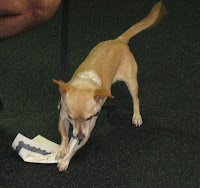
Which brings me to the topic of dogs and consuming anything that isn't nailed down! Check out the photo op of Sir Poncho the Graduate chewing up his latest Manner Class certificate... Fortunately, it was for the pleasure of chewing and not consuming.

Let's revisit what dogs are: scavengers, predators, and omnivores! >>> they'll eat anything at any time, and it's more fun
if it's moving! They are also chewers! And they chew for a variety of reasons.... Put it all together, they'll eat anything! Sometimes they just chew it, sometimes they eat it, and sometimes they'll even "guard" it so you won't take it from them! Hello? This is normal
behavior, and it's hard-wired into their doggy DNA - it's one characteristic that makes dogs dogs!

I recall during my training up at the San Francisco SPCA there was one particular dog (Freddy, see pic of the handsome shepherd mix) that was very clever at grabbing the trainers treat bags
off their waistband, removing the ziploc baggy of treats from inside of it, and ingesting the entire thing! I wasn't there either time, but the first time he was rushed to the vets, the second time the trainers rolled their eyeand remembered not to use a treat bag when working with him. Live and learn, right? You would think dogs would learn too, but alas, it seems the ingesting of something, even some innate object, is usually more motivating than the punishment of aftermath.

One other comforting thought was when my dear friend Emilia emailed me on Monday saying she was swamped the entire weekend because her dog Nellie had eaten a highlighter! Emilia
and her hubby realized this after seeing all the ink on Nellie's rear end. They spent their weekend observing Nellie for "odd" behavior...(odder than usual I guess?) :-) Check out Nellie's pic on the left... I guess she was considering interior decorating as a new career. Fortunately mom and dad have provided many new legal outlets for her, and the pillows are no longer an appealing choice.

Well, I guess if Nellie can tolerate a highlighter, then Poncho and his extra fiber would be okay...although, I would never ever ever add something like that into his diet intentionally, nor would I risk leaving something like that around - As we have come to learn, dogs sometimes don't have the best judgement when it comes to meal planning.

Another few things I'd like to add about dogs and chewing/ingesting anything is:
  1. If your dog does, or you think your dog did ingest something that could harm them TAKE YOUR DOG TO THE VET! (or at least call your vets office) It's not our job to evaluate our dogs health if we're not a professional veterinarian.
  2. Determine WHY your dog is chewing, destroying, or eating things they should be chewing, destroying or eating! Is it boredom? Is it because of isolation distress or separation anxiety? Is it because they're teething? There are many reasons why dogs do any of those things. First determine "the why", then you can make plans on what to do about it, if in fact you need to change your dogs behavior.
  3. Supply your dog with "legal" items, then reward them when they're making the better choice. Check out the picture of Poncho and his "legal" items.
For more intriguing anecdotes on items that dogs eat, check out this great Web site that Matt Goodman and his dog Watson have developed called: Things My Dog Ate! After looking at his site, I can honestly say Poncho ain't that bad when it comes to ingesting the non-food items... we'll just keep the wrappers away, and count our blessings.

If you have questions about chewing, ingesting, or guarding, or want to teach your dog some training exercises that would help with any of these issues, please contact me. My classes and workshops at the inquisitive canine studio and Ventura College Community Education, and of course privates can help you and your dog.

Monday, 3 November 2008

Puppy and Dog Problem Behaviors: Whose "PROBLEM" is it?

A friend and colleague writes: "I need pet experts to offer me their top tips on treating the common problems of cats and dogs at home for a chapter in a 'pet problems' book being revised. Care to submit something?" Well shoot! Of course I do... I'm always willing to offer up my opinion, especially if it can help others.

The following are some of the more common issues that come my way, regarding dog behavior:
  • House-training: Dogs come with a pre-wired, instinctual set of elimination behaviors. It's up to us to teach them where and when to go in our human world. A few key things are:
  1. Consistency! Teaching them to "go potty" in a multitude of areas can be confusing. Stick with one general place (outside) and reward them for it!
  2. Timing! Reward them when they go it the desired place!
  3. Refrain from punishment of any kind. This doesn't teach your dog what you want - it only teaches them to be afraid of you and to not eliminate in front of you. Or if it's after the fact, then they don't put it together. You may end up punishing something completely unrelated - like coming to you.
  • "My dog is afraid of ": Socialization is key. Whatever you want your dog doing as an adult, begin to get them used to it as a puppy - small, baby steps. New smells, sights, sounds, textures, and situations. This doesn't mean you should be taking them to places that could cause harm, but you can still get them used to, and exposed to "novel" things when they're young.
  • Note: Dogs learn the same way we learn. So for adult dogs, even if you've missed the prime socialization period (6 - 13 weeks), you can still teach them to love or hate almost anything. Pairing something they already love (or hate) with anything else, will teach (condition) them to love or hate the "anything" else. Think Pavlov.
  • "My dog chews up/destroys anything and everything." Let's recap what dogs are: predators, omnivores, scavengers. They chew for a variety of reasons. They're also "individuals" in that they have their particulars about what they like to chew. Experiment with different "legal" chew items. Determine which one(s) your dog likes the best. Then, when s/he makes the right choice, reward extra for making that choice!
  • "My dog barks all the time!" Okay, first off they're dogs. Remember "Old MacDonald"? Dogs bark for a variety of reasons, just like we humans talk/yell/scream (dare I say whisper) for a variety of reasons... First determine "why" your dog is barking, then figure out what to do about it. Fear and separation anxiety is a completely different path of learning than play or attention seeking, as well as alert/predatory/play/territory barking. In a very tiny nutshell:
  1. Fear-based: longer process to teach your dog that being alone is "fun", and that they can trust it's going to be okay. Be boring coming and going, short absences working up to longer periods, exercise beforehand so they're tired and want to rest, pet sitters, day care, play-dates, enrichment.
  2. Boredom: Enrichment! Give them something to do! Exercise them so they're tired.
  3. Attention seeking: Ask them to do something else. Interactive games (enrichment). Reward when they're quiet! Time-out if necessary.
  4. Alert!: If there is a burglar on the premises you better thank them for doing their job! If it's a friend visiting, or the delivery person, thank your dog for letting you know, then ask them for another behavior (instead of continuous barking). Reward for quiet, time-out for making the wrong choice.
I think one of the more important steps any dog guardian should take is learning what they can about dogs in general. Know your animal! What makes them dogs? Why do they do what they do? Understanding them better can help set yourself and the dog up for success, while avoiding those "problems" people complain about.

Friday, 31 October 2008

Lots of yummies for this little 'trick or treater'!

Poor Poncho. He is the best ever! How many dogs would allow their nails to be trimmed, then follow it up by being dressed up for Halloween - as a food item no less! Too cute... check it out>>>>

I did make it "fun" for him though. For nail trimming he got leftover rice cake crumbles (he loves 'em), with mixed in lamb jerky. For the "lobster" outfit he got the same treats, plus some "ball time", which he finds very rewarding.

See? Just goes to show you 1) you can train a dog to like anything (almost) 2) you can use many things besides food to reward your dogs great behavior!

Happy and safe Halloween, from me and my sidekick Poncho! AKA: my "rock lobster"

Sunday, 28 September 2008

Bringing clarity to clickers and positive reinforcement:

You hear the words "Clicker training", "Clickers", "Positive Reinforcement" etc... but what's it all mean? Let me try to help clarify some points:
  1. Using a "Clicker" doesn't mean a person doesn't use "punishment" (hopefully not at the same time)...
  2. Positive Reinforcement doesn't mean a person doesn't use punishment.
  3. Positive reinforcement doesn't mean a person doesn't use physical force to get what they want!
  4. Using "punishment" doesn't mean a person uses physical force or inhumane methods to teach.
  5. There are two types of "punishment":
  • "Negative Punishment": Taking the good thing away
  • "Positive Punishment": adding something the animal wants to avoid - a smack, shock, choke, prong in the neck, citronella spray, loud noise, being pinned, etc...
Why do I bring this up? A couple of reasons. There are some trainers out there that say they're somewhere between "A clicker trainer" and a famous trainer who uses physical force, flooding, fear tactics, and downright "old fashioned" training methods. (Sorry, name withheld to protect privacy and CMA)...

I wanted to say to this person: "What does being a 'clicker trainer' mean to you?" It certainly isn't exclusive to causing no harm to an animal - it's just another tool in your trainers toolbox, as it is mine. It "marks" the behavior you wanted your dog (or any animal) to perform...not much more.

I use a clicker as one of my training tools. I also use "punishment". As a matter of fact I spoke about it today in my Manners Class at the Inquisitive Canine studio. However, the type of 'punishment' I use and teach has to do with "reward removal" - not hitting, beating, shocking, spraying, coercing, forcing, or bullying!

No animal learns that way without resulting in some nasty (usually "emotional") side-effects. Do animals learn through beating and force techniques? Sure they do - or should I say, "we" do... But what else are they "learning" besides what the owner/parent wants? - which is usually not the first or main thing they learn...

My final example: I was coming home from a run, heading in the opposite direction of a man and his dog. I'm sure I looked "weird" to the dog...hat, sunglasses, water bottle belt, running right towards it. This can be perceived by dogs as "threatening", right? Something weird running at it... So the dog did the most logical thing it could do in it's little canine brain - it started barking at me - I didn't blame it at all. Unfortunately the owner did - and proceeded to smack it repeatedly on the head! The dog looked at me, barked, got smacked and yelled at. I cringed! I think I yelped myself! Then screamed at him to please not hit the dog!!! Why is he hitting him! it doesn't teach him what you want!

I know, that can be pretty punishing to someone - being yelled at it public. As for "positive punishment" towards humans - of course I'm against it (unless it's self defense) - However, I did have a secret desire to smack the owner and take the dog... Hopefully they will end up in one of my classes - either at the studio or Ventura College, so I can supply an education in positive reinforcement, learning by both association and consequence, proper ways to get rid of unwanted behaviors, and clickers (or not).

Sunday, 7 September 2008

You CAN teach an old dog (man) new tricks!

Okay, let me first say he's NOT OLD! My "man" that is... But, he can learn new things... Yep, three years after becoming a trainer and establishing The Inquisitive Canine, a year and a half since opening the studio...and my own husband, father of our dog, love of my life, supporter of all I get into, has finally signed up for one of my classes with our dog Poncho! I couldn't believe it... but he said he finally believes that 1) the training does work, and 2) he needs to learn some of these techniques so Poncho will perform the same behaviors with him as he does with me.

For years I've said that dogs don't generalize (perform same behavior in similar situations) - and that we need to re-teach them in any new situation. A new place, person (different person training), situation etc... you have to re-teach the dog...it's as simple as that. I'm not too sure what finally sent my hubby over the edge of not being convinced to actually "believing", but I'm thrilled he's finally there! And that he is excited about coming to class and learning... He even filled out his goal sheet and is reading through his workbook!

I have to say, this has made my day - and is SO rewarding to me! I love how we positively reinforce one another - makes for a great relationship... Now I'd better go catch him in the act of doing what I love and reward him for it! (husband and the dog)...

Friday, 20 June 2008

All choked up over this question:

I was having a discussion on the use of choke chains with dogs - and the question came up about using them on stronger dogs, especially Pit Bull Terriers. Let me say this first: 1) I love Pit Bulls. 2) I am NOT breed biased. Doggy DNA is doggy DNA - they all have the propensity to act like dogs whether they be a teacup chihuahua or an american pit bull terrier. The difference is obvious when it comes to the injury itself, and in that: size does matter... This is what I told my friend who asked the innocent question of using them on APBT's (she lives in a big big city with APBT's everywhere...and she doesn't own a dog herself...it's okay, she's still really cool)... Anyway, this was my answer for her:

but what if you have a pitbull in brooklyn (there are millions!)? just askin.. > Are you kidding? Please allow me to pass on some info: "all" animals learn the same way- So, if you have a 6' 8" athletic boxer, or a 3' tall little girl, a lion, a tiger, a bear, a fish, a hamster, cat, or Pit Bull Terrier - all will learn the same way - The way that humans use choke chains for training places them (the collars) under the "Learning by Consequence" path - Based on the consequences of the animals own behavior you can either give them something they want, or take it away - or you can give them something they don't want, or remove it, or prevent it from happening. (BF Skinner come to mind here?) Anyway, the more *humane* techniques are: give something they want, or take it away - like sports (three strikes, penalty box, and that whole deal)... Dog sits = he gets a treat and gets to say *hi* to person - Dog jumps up = dog doesn't get treat and doesn't get to say hello to person.

Choke chains, prong collars, squirt bottles, jerking the collar (collar corrections), electronic shock collars, citronella collars - all of these *positive punishment* techniques are threats, considered abusive, and only motivate the dog out of pain and fear! Plus, they only focus in on what you DON'T WANT, not what you do want... If you were involved with someone that walked around with a belt in their hand, ready to hit you with it if you did something THEY didn't like, and only paid attention when you were doing something *wrong* (only in their eyes mind you - could be a normal behavior of yours...) how long would you stay with this person?

As I mentioned above choke chains (and the like) are used for the purpose of "Consequence Learning". However, both types of learning are taking place at the same time (the "emotional" learning by association path), and thus creates a main reason for dog aggression to start - but that's a different email (post)...I'll let you digest this one first.

This is just some of the info I talk about in my classes and workshops here in Ventura... you to can learn more about this path of learning, and well as the other - stronger path... You and your dog will love it!

Sunday, 18 May 2008

The better dog behavior question leading to success!

When it comes to the behavior of our dogs, we often ask ourself: "Why do you keep doing that (dogs name)?" As a dog trainer I get calls all the time with that question. At home, being a *dog mom* first, I will catch myself asking myself this question...usually on Mondays when the garbage trucks are circling the neighborhood about nine times throughout the day... So, what's wrong with this picture??? We're just focusing in on what we don't want - what drives us nuts - which doesn't solve anything. What we need to do is simple... we need to ask the right question: "What behavior do I want?"

From that answer you can say to yourself: "Then this is the behavior I want to reward!" For instance, let's say I want my own dog Poncho to be quiet while he is hanging out in the yard. I do allow him to bark once (to alert me, after all, that's part of his *job* description)... So, being out there and just being quiet gets him rewarded! I make sure to catch him in the act of doing what I want, then acknowledge it, and reward. "Thank you!" If it's a situation where I want him to bark I allow him to continue, if not, then I give him a separate cue for wanting quiet. If he follows it, he gets rewarded - food, play time, freedom in the yard - if not, then inside he goes. "Too bad for you."

Now he has the choice: stay outside following the rules gets rewarded - breaking the game rules gets him nothing.

This is the type of training steps I teach in my classes - it's simple, it works, plus it gets you focused on what you want, not what you don't want... So remember, the next time you find yourself frustrated with your dog, just ask yourself "What behavior do I want? What behavior do I want to reward?" Then do it!

Friday, 4 April 2008

This dog trainer is such a hypocrite!

I'm talking about me folks. The patient dog trainer and human-dog relationship coach... the one who is able to fix everyones else's issue's with their own dogs... Yep, I'm the hypocrite. Making a public announcement and apology for everyone to hear. Ready? Okay...here goes...

I'm a barker!!! That's right - ME! I bark...sometimes way too much. Now, you wouldn't think so. After all, I'm not a dog (I'm trying to forget what they called me in high school, but that's another story...) But it occurred to me as I was driving around town, Poncho in the backseat, tucked in his car seat all safe and sound... and being quiet as could be. I've trained him pretty well - just like I help others in my dog training classes at The Inquisitive Canine. Once in a while I have to "go back to kindergarten" and remind him with some rewards for being quiet (and a time out if he's barking too much)... But this time it was all my fault. Me, the dog trainer, the one who teaches dogs to be quiet...I was the one being loud and obnoxious - "barking" at all those drivers on the road either causing traffic jams, not paying attention to everything around them... "HEY! The light's green! For gosh sakes hang up the phone and pay attention!!!" "And YOU! If you want to change lanes, then signal! They don't design cars with turn signals for nothing!" "And hey you, driving is a privilege not a right! Obey the laws like everyone else!" Wow...listen to me I'm barking again.

Poncho...my sweet boy. Mama is sorry. I've been barking in the car too. And you've been so kind as to not give me a time-out! Next time, instead of me barking, I'll redirect my energy and reward you for being quiet... Extra treats for you - and some "pet therapy" for me.


Saturday, 22 March 2008

The *hunt* is on for my top dog!

I love Easter... Why? Because I get to play "dog mom" to my little one Poncho. I know I know, even though I am a positive reinforcement dog trainer here in Ventura at The Inquisitive Canine. I do know I'm an over-the-top dog mom too. Every Easter I like to set up a "kibble hunt" for Poncho in our back yard. This is actually something I often do for him as an "enrichment" activity. But it's special for me today because 1) it takes me back to my own childhood... 2) makes me feel part of the crowd with the rest of my friends that have *hunts* with their human kids...


This time I allowed him to watch me set up the hunt...a little different from years past. Why? Not sure...just felt like it. Anyway, I started out by leashing him to the bench in the yard - then walked around dropping and placing pieces of his kibble (and a few extra yummy treats) in various places in the entire backyard. Under plants, between rocks, behind furniture... He was going wild! Very excited throughout... Kept offering a sit and down stay for me (check out the picture). He has learned that these two behaviors get rewarded - a lot, so why not keep offering them... I love that he has figured out how to make the right choices... (something I teach in my dog training classes) Anyway, once I let him go Poncho was all over it! Kept him busy for quite awhile - tapping into that predatory drive, fulfilling those desires to hunt...plus kept him out of my hair long enough to have my own breakfast. He has to eat anyway, right? I just like to use his meals to my advantage while making it more fun for him...

This is an activity I recommend for my clients - you too can learn more about enrichment, and preventing the "boredom blues" in the classes I teach at my rockin' indoor dog training studio - The Inquisitive Canine...

Monday, 10 March 2008

Dog Behavior: a realistic look

Poncho and I just got home from spending a nice romp on the baseball field. Before we walked around ourselves I spent a few minutes just watching the young kids with their parents playing catch, doing warm-up drills, and getting settled in before they started their game. I noticed there were some kids throwing the ball in every direction they could - even if no one in particular was there to catch it...just giggling and flailing about - having such a great time. Then there were the two boys that were rolling on the grass...down the hill, just rolling and rolling and rolling... I started giggling - remembering doing that as a child too, and having so much fun.

My question today is: how come all we expect from children is to laugh, play, enjoy themselves, not talk to strangers, and maybe say please and thank you? We don't ask them to problem solve every issue they may encounter or even leave it up to them to entertain themselves - unless we supply or arrange the activities. Why do I bring this up? Because it seems we expect differently from our domestic dogs, even though they are mentally equivalent to a two year old human.

So, what are we supposed to do? I say, treat them as dogs, while having expectations that would equate to what they're capable of doing, not what we wish they could do. If your dog has never learned to *retrieve*, then you can't expect to throw the ball fifty yards and have him or her go fetch and bring it back dropping at your feet on the first try. Maybe they will! If so, throw a party! If not, then teach your dog what you want in a way they would understand. Making it simple, like the kids learning T-Ball first, before moving up the difficulty ladder. Set them up for success! Otherwise you may be the one that gets frustrated.

Skills like this are discussed and taught in my own classes here at The Inquisitive Canine in Ventura. We talk about making training steps easier or more difficult for you and your dog. When you are learning something new, or when you're wanting to advance on the skills your dog already knows... It's lots of fun, but we still focus on realistic expectations. Makes for a much more fulfilling and rewarding time.

Friday, 15 February 2008

How long does it take to train my dog?

A FAQ I receive is: "How long will it take for my dog to be trained?" I hate to say it, but there is no simple answer...or magic wand. Every persons situation and dog is different. Whether it be a puppy that has been brought into a first time dog owners home, or a intra-familial dog-dog aggression case - all depend upon the humans that are taking care of the dog(s), and the dogs themselves. Some factors to consider are:
  • Type of training - general manners, aggression/fear, guarding/predatory issues.
  • Human involvement - keeping up with the training plan, setting the dog up for success.
For "good manners" courses I currently offer 4-session "intensives" as opposed to the traditional 6 week+ classes. Why? I found that most people are more likely to commit to a shorter time frame if they are receiving the information they want. And that for those that are into keeping up with their dogs behavior modification, will return for additional class time (my ongoing classes provide this type of training plan).

For the more difficult behaviorial issues, again it really depends upon the humans and dogs. But I would place more emphasis on the "humans" and their involvement. Think about how long it takes a human to change something about their own behavior? Something like smoking cessation takes quite some time to get over the "initial hump". Afterwards, the person will need to help maintain this behavior by setting themselves up for success - spend time around non-smokers, go to places that don't allow smoking etc... But it's a lifelong process. With our dogs, there would be the "initial hump" - meaning more training. Once the dog is behaving in a way you want, you will still need to set the dog up for success, and help "maintain" the behavior by practicing elements of the initial training plan... Some of the dog-dog cases I've worked took many many months - with multiple training sessions every day, for extended periods of time.

So when I hear people asking me "how long will it take to train my dog?" I will ask "How much time, energy, and in some cases money, are you willing to put in?" and "How badly do you want it?"

Wednesday, 13 February 2008

Changing behavior...Who me?

behavior modification |noun
the alteration of behavioral patterns through the use of such learning techniques as biofeedback and positive or negative reinforcement.

Why does training your dog have to be such a difficult process? Why why why? Hmmm, well, it doesn’t really. I think as humans we just make it as such...that is our innate behavior, no? ~ Let’s see. Behavior = the way in which one acts or conducts oneself. Just being alive is performing a behavior right? Sleeping in front of the TV is a “behavior”. Okay, that’s a simple one... It’s the whole “modification” process that sends us into a tizzy. After all, if we want to change someone else’s behavior we have to start with changing our own... Yikes! That’s too much work! Nah, it really doesn’t have to be...you just need a plan. Once you have a plan, consisting of a just a few small steps that you can fit into everyday life, then it too becomes part of your regular schedule... And therefore, a simple approach to reaching your goals...

Just go and experiment yourself... Pick one thing you love your dog doing. Then, be aware of when your dog is performing this behavior, and make sure you reward him or her with something that motivate them. Either a “treat”, praise, petting, playing a game. Something they find rewarding... This tells them “thank you”, “I appreciate that”. After all, don’t we all appreciate someone appreciating us.

Simple yes? Good. See? You’ve already modified your own behavior. Now, it’s time to go modify your dogs.


Dog Toilet Training Copyright © 2016 -- Powered by Blogger